

Dhamma attainment : ค้นหาหนังสือธรรมะ หน้า 3 / 7
หน้าหนังสือทั้งหมด
55
Implications of Dhamma and Brahma in Buddhist Teachings
While a conclusion is proposed here to some extent, it may be useful to examine further implications from the parallel usage of the term 'dhamma' and 'brahma' elsewhere, for it may add further underst
เนื้อหานี้สำรวจการใช้คำว่า 'ดัมมะ' และ 'บราเหมะ' ในวรรณกรรมพุทธศาสนา และการตีความความหมายที่เชื่อมโยงกันของทั้งสองคำ เป็นการศึกษาความสำคัญของการใช้คำที่ขนานกัน ซึ่งสะท้อนถึงสถานะความบริสุทธิ์สูงสุดที่
20
Superior Love through Superior Dhamma
Superior Love
through Superior Dhamma
Because we are human beings, none of us are perfect.
We all come with a baggage of deficiencies. We can
cope with our own deficiencies but we cannot
tolerate some
This text discusses the challenges of living with a partner and how the Dhamma provides guidance for a harmonious family life. It highlights the four virtues: truthfulness, self-control, endurance, an
50
Journey to Dhamma: A Personal Transformation
ERVICE
merits. If I had huge problems, I would make huge
merits. This was how I learned about Wat Phra
Dhammakaya in 2001, under the guidance of a good
fellow (kalyanamitta) from Korat who suggested t
This text chronicles a personal journey of spiritual growth, initiated by the author's experiences at Wat Phra Dhammakaya and the DMC program. From the suggestion of a friend, the author contributed t
54
Raising Smart and Virtuous Children
utilize the four requisites, how they work, and how they
conduct their daily activities.
Parents can instill wholesomeness, intelligence, and
compassion towards others by teaching their children respe
การเลี้ยงดูเด็กอย่างชาญฉลาดรวมถึงการปลูกฝังคุณธรรมและสติปัญญาผ่านการสอนการเคารพวรรณกรรมและประสบการณ์ของคนที่มีคุณธรรม โดยการใช้สี่สิ่งจำเป็นในชีวิตและความวิตกกังวลเรื่องความรู้ทางโลกและผลงานของธรรมะเด
123
The Great Refuge of Humankind: Understanding the Teachings of the Lord Buddha
1. The mentor should have an unambiguous
biography. There must be proof of his life history; it can not
be vague and unreliable.
2. He must be extremely intelligent, exceptionally
virtuous, exceedingl
This text examines the criteria for an exemplary mentor, using the Lord Buddha as a prime example. It highlights the importance of a well-documented biography, exceptional knowledge, and the ability t
123
The Teachings of the Lord Buddha
1. The mentor should have an unambiguous biography. There must be proof of his life history; it can not be vague and unreliable.
2. He must be extremely intelligent, exceptionally virtuous, exceedingl
The mentor should have a clear biography and proven life history. Lord Buddha fits this as His documented life is a testament to His wisdom and virtue. He sought truth independently, achieving enlight
39
Interpretations of Dhammakāya in Early Pāli Texts
Gombrich, while differently translating the term in this passage as a bahubbiha compound 'dhamma-bodied,' similarly interprets it as an indication that the Buddha's true import is due to 'his teaching
This text delves into various scholars' interpretations of the term 'dhammakāya' within the context of early Pāli suttas. Gombrich views it as 'dhamma-bodied,' emphasizing that the essence of the Budd
57
The Concept of Dhamma and Kāya in Buddhist Philosophy
On the whole, it appears that the terms dhamma and brahma constituting four designations of the Tathāgāta are used in the sense of the ‘highest.’ It is most likely that they refer to Nibbāna.
This i
This study examines the terms dhamma and brahma, suggesting that they refer to the highest aspect of Tathāgāta, likely Nibbāna. The term dhamma denotes transcendental realities, transcending the realm
115
Understanding Boon and Dhamma
Suzanne Jeffrey
Q: How is boon generated?
A: Boon is created by doing good acts, keeping precepts, meditating, and listening to the Dhamma. You can feel the energy that is created by these four thing
Boon is generated by good actions, keeping precepts, meditating, and listening to Dhamma. It creates positive energy that purifies the mind. Conversely, baap, or bad energy, arises from negative thoug
100
The Virtuous Realm of Celestial Beings
They are pleased to practice the Dhamma because they have been staunch merit makers. There are Bodhisattas that are well-versed in the Dhamma. They take turn giving a sermon to the masses. Although ce
In this celestial realm, beings engage deeply in practicing Dhamma, led by King Sntusita, who values virtue and knowledge. Celestial beings attend discourses and sermons, sharing wisdom and warm embra
17
Dhamma Practice and Understanding in Dhammacakkapavattana Sutta
translation are hampered in their studies both by the scarcity of the original and its archaic language. In spite of the present author's respect for the original use of language, to leave it in its o
This work addresses the challenges of understanding the Dhammacakkapavattana Sutta due to its original language and scarce resources. The author adapts complex passages to modern language while mainta
106
Understanding the Middle Way in Dhamma Practice
In terms of practice however, Luang Phaw Wat Paknam explained how we can know we are practicing the Middle Way in the sermon he gave on the Dhammacakkapavattana Sutta on 3 January 1955. He explained t
In his sermon on the Dhammacakkapavattana Sutta, Luang Phaw Wat Paknam elucidates the profound significance of the Middle Way, urging practitioners to find stillness at the body’s central point. This
112
Understanding the Dhamma Body and Overcoming Mental Defilements
to enslave the mind and how we can overcome them. This is a major difference from the naked (physical) eye to which the defilements are invisible. The limits of our human senses are to know the manife
The passage discusses the limitations of human senses in perceiving mental defilements such as greed, hatred, and delusion. It highlights the importance of the Dhamma Body in providing insight into th
193
The Subtlety of Dhamma and the Buddha's Vocation
Dhamma in even greater subtlety. The Buddha was later to preach in the Simsapa forest that there were more leaves in the forest than he held in the palm of his hand. The 84,000 units of Dhamma which
The Buddha preached the concept of Dhamma, comparing his teachings to leaves in his hand versus the endless phenomena of enlightenment. He remembered his vow to end suffering, driven by compassion for
52
Understanding the Noble Eightfold Path and Threefold Path in Buddhism
[Right concentration, again, becomes the basis of right views, right aspirations, and other steps of the noble eightfold path, which is now experienced on a higher level, and this spiral-like progress
This text elaborates on the interrelationship between Right Concentration, Right Views, and Right Aspirations as pivotal elements of the Noble Eightfold Path leading to liberation. It discusses the sp
50
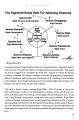
The Eightfold Noble Path for Attaining Dhamma
The Eightfold Noble Path For Attaining Dhamma
1. Samma Ditti - Right View and Understanding
2. Samma Sanggappa - Right Thought
3. Samma Waja - Right Speech
4. Samma Gammanda - Right Action
5. Samma A
The Eightfold Noble Path consists of eight practices that guide individuals towards the attainment of Dhamma. Each aspect emphasizes practical and mindful approaches to living, including Right View, R
220
Exploring the Path to Enlightenment in Buddhism
101; enlightenment mechanism, chanting, Dhammacakkapavattana explained by Dhammakaya 111; Sutta 10-11, 209-16 knowledge arising to reach enlightenment 140-1; practice 94, metaphors: dog and lion 94; g
This text delves into various aspects of Buddhism, focusing on the mechanisms of enlightenment through chanting and the Dhammacakkapavattana Sutta. The practices necessary for attaining enlightenment
116
Understanding Nirvana: The Realm Beyond Existence
same happiness to us as if we were really in āyatanā nibbāna — but we are still ‘alive’ in our human body.
2. Nirvana without residual aggregates (Anupādisesa Nirvana [Nibbāna]) is the Nirvana that is
This text delves into the concepts of Āyatanā Nibbāna and Anupādisesa Nibbāna, explaining that Nirvana exists beyond the physical realm and is not bound by worldly elements. It describes Nirvana as a
122
Truth for the Family
Part Five: Truth for the Family
physical attempts upon His life. However, they had no
effect on His strong determination. Furthermore, none
of His actions were for personal gain. When offered
valuable
This section emphasizes that the Dhamma teachings are accessible and beneficial to all, promoting personal growth and the possibility of attaining Nibbana. It highlights the importance of practicing D
27
The Search for the Answers of Life
The Search for the Answers of Life
While he was attending Suankularb Wittayalai School, he had a chance to listen to Dhamma lectures, from many scholars, and that inspired him and his friends to esta
This text chronicles the journey of a young boy attending Suankularb Wittayalai School, who, inspired by Dhamma lectures, forms a Buddhist Youth Society. His passion for understanding life leads him t